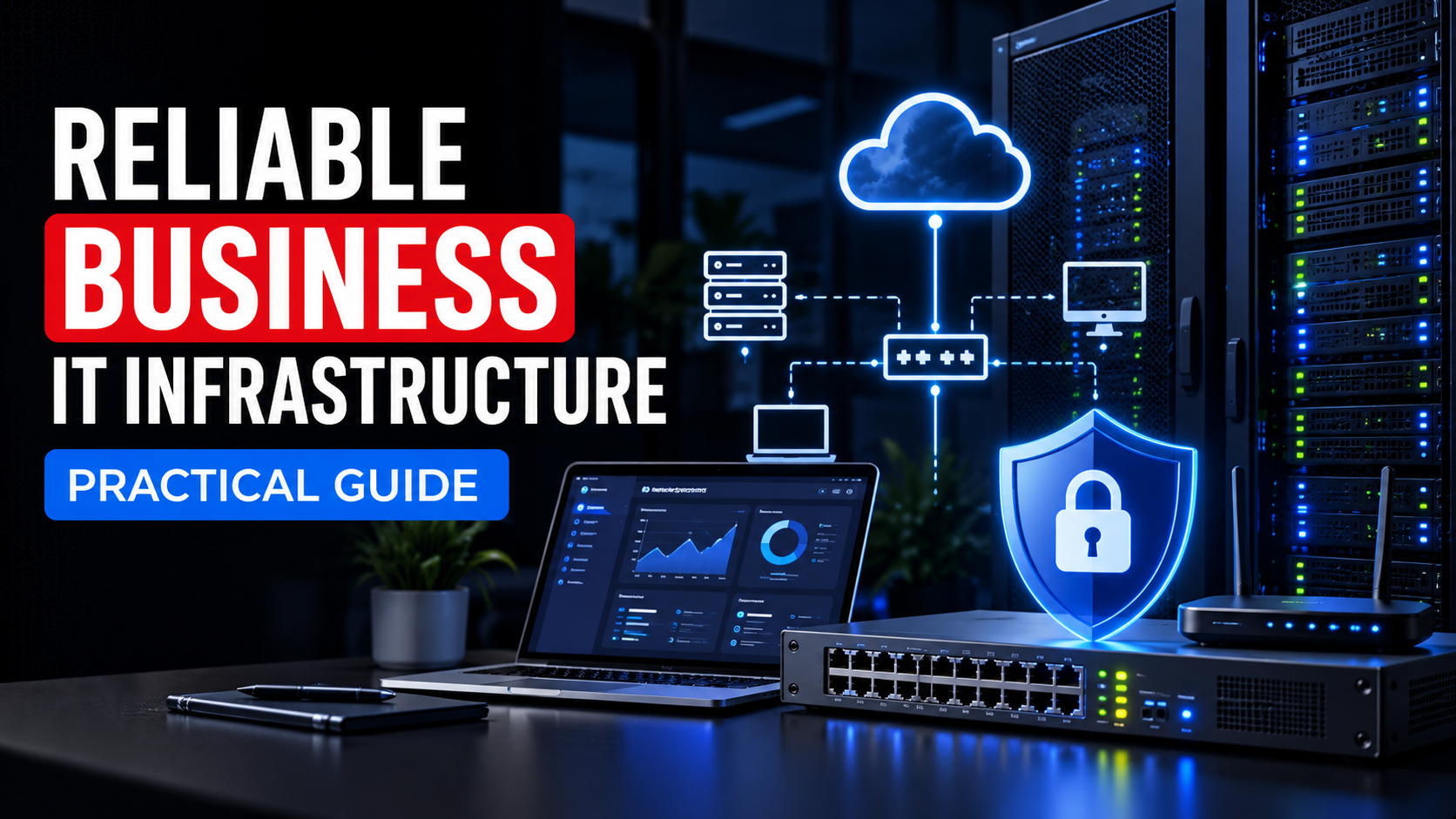
How to Build a Reliable Business IT Infrastructure
Business IT infrastructure is the foundation of stable and secure daily operations. A well-designed environment should support employees, protect company data, reduce downtime, and make future growth easier.
A reliable infrastructure usually includes a properly configured network, secure internet access, user and device management, backups, monitoring, and clear documentation. It should also be easy to maintain without depending on temporary fixes or undocumented settings.
Business IT Infrastructure: Network Design
The network is one of the most important parts of any business IT environment. Routers, switches, wireless access points, VLANs, VPN connections, and firewall rules should be configured with both performance and security in mind.
For many small and medium-sized businesses, solutions based on MikroTik and UniFi can provide a good balance between flexibility, performance, and cost. Proper segmentation of users, servers, IoT devices, and guest networks can significantly reduce security risks.
Identity and Access Management
Business IT infrastructure should also include controlled access to company systems. Platforms such as Google Workspace can provide centralized user management, authentication, email, file sharing, and collaboration tools.
Multi-factor authentication, strong access policies, and regular account reviews are important for reducing the risk of unauthorized access.
VPN and Remote Access
Remote access should be secure and predictable. WireGuard VPN is a practical option for connecting employees to internal systems and office networks.
A well-configured VPN should provide access only to the resources a user actually needs. Monitoring active connections and maintaining clear peer documentation also makes troubleshooting easier.
Business IT Infrastructure Monitoring And Maintenance
Reliable infrastructure requires continuous monitoring. Network availability, server status, storage usage, backups, and critical services should be monitored before users notice a problem.
Preventive maintenance is usually more effective than reacting only after a failure. Regular updates, configuration backups, and documentation can significantly reduce recovery time.
Business IT Infrastructure for Long-Term Growth
Good Business IT Infrastructure should remain understandable, maintainable, and scalable. The goal is not to use as many technologies as possible, but to build an environment that reliably supports the business.
A structured approach to networking, security, access control, monitoring, and documentation helps create an IT environment that is stable today and ready for future growth.
You can also explore my IT infrastructure and support services for businesses.